The Panther
The Panther
— Rainer Maria Rilke (translated by Douglas Pinson)
His worldview from the constantly moving bars
Has become predictable, boring and cannot hold
Anything more. The black cat sees a
Thousand bars, and beyond the bars, nothingness.
As he paces again and again in cramped circles,
The movement of his powerful, athletic strides
Is like a ritual dance circling a core
In which a mighty will is engulfed in stone.
Only now and then the curtains of each pupil
Lift, slowly–. An image, a sound enters in,
Rushes down through the tensed, locked and waiting
Muscles, plunges straight into the heart and disappears.
I came across this translation on Spinoza Blue
So, you want to be a writer?
This is intended as a note to self.
if it doesn’t come bursting out of you
in spite of everything,
don’t do it.
unless it comes unasked out of your
heart and your mind and your mouth
and your gut,
don’t do it.
if you have to sit for hours
staring at your computer screen
or hunched over your
typewriter
searching for words,
don’t do it.
if you’re doing it for money or
fame,
don’t do it.
if you’re doing it because you want
women in your bed,
don’t do it.
if you have to sit there and
rewrite it again and again,
don’t do it.
if it’s hard work just thinking about doing it,
don’t do it.
if you’re trying to write like somebody
else,
forget about it.
if you have to wait for it to roar out of
you,
then wait patiently.
if it never does roar out of you,
do something else.if you first have to read it to your wife
or your girlfriend or your boyfriend
or your parents or to anybody at all,
you’re not ready.don’t be like so many writers,
don’t be like so many thousands of
people who call themselves writers,
don’t be dull and boring and
pretentious, don’t be consumed with self-
love.
the libraries of the world have
yawned themselves to
sleep
over your kind.
don’t add to that.
don’t do it.
unless it comes out of
your soul like a rocket,
unless being still would
drive you to madness or
suicide or murder,
don’t do it.
unless the sun inside you is
burning your gut,
don’t do it.when it is truly time,
and if you have been chosen,
it will do it by
itself and it will keep on doing it
until you die or it dies in you.there is no other way.
and there never was.
— Charles Bukowski
On children
Khalil Gibran was a wise man. An excerpt from ‘The prophet’.
And a woman who held a babe against her bosom said, “Speak to us of Children.”
And he said:
Your children are not your children.
They are the sons and daughters of Life’s longing for itself.
They come through you but not from you,
And though they are with you, yet they belong not to you.
You may give them your love but not your thoughts.
For they have their own thoughts.
You may house their bodies but not their souls,
For their souls dwell in the house of tomorrow, which you cannot visit, not even in your dreams.
You may strive to be like them, but seek not to make them like you.
For life goes not backward nor tarries with yesterday.
You are the bows from which your children as living arrows are sent forth.
The archer sees the mark upon the path of the infinite, and He bends you with His might that His arrows may go swift and far.
Let your bending in the archer’s hand be for gladness;
For even as he loves the arrow that flies, so He loves also the bow that is stable.
When New York slept.
When it was time for New York to sleep, loneliness abounded and the fog grewand the wind got off the ship and walked on the shores.Within these 4 glass walls, my candle and Iwhat loneliness, what torture.With words like lullabies, you aren’t here to lull me to sleepnor to wake me in the morning with coffee and a kissnor to remove the mote of dust from my eyenor to soothe the confusion in my mindMe here, you there, in this loneliness the minutes become years, I wonder whyAnd why have we become an explanation for the saying ” the sky’s here, the blue’s there”In my calendar, my pen writes your name a hundred timesand is your name honey that ants surround it as soon as I doeven though the earth is cold, this moment my winter becomes hot summerbut the moment you come where I am, the heat wave becomes ice
We, the living.
Leo Igwe over at Culture Kitchen has an interesting post about the human condition and why we are the way we are, in an African context. An excerpt:
The Nigerian author, Ben Okri in his book, A Way of Being Free, said, “There are many ways to die, and not all of them have to do with extinction. A lot of them have to do with living. Living many lies . Living without asking questions. Living in the cave of your own prejudices. Living the life imposed on you, the dreams and codes of your ancestors”
Life boils down to choices. Whether informed or uninformed, with foresight or hindsight, the choices you make determine what kind of life you lead. It is important however that you make the choices and not let the choices make you! This is slightly paradoxical but what I am getting at is a desire for lifelong agility of mind. The ability to absorb new ideas, new perspectives and change when I encounter something “better”. This is the only way to be free, truly free. Like the axolotl which remains in its larval stage forever, I want my brain to be 18 till I die!
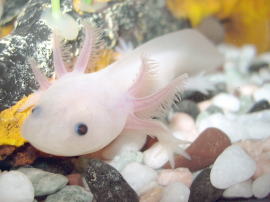
This is probably an adult, or maybe not 🙂
Enlightenment and shyte
im’ma go away to a deserted island
and read and think and write and shyte
and then there’ll be a thunderbolt
and enlightenment will be mine
meh, thats not how it works,
enlightenment is shyte, overrated and all,
its a dark world, nobody gives a shyte about you!
so what if you want to be the ubermensch?
shyte, shyte, shyte, shyte, shyte!
how shall i make my choices!
tranquilo, tranquilo, silencio, silencio
no hay banda, no hay orquestra, it is all an illusion,
what people will come, what places will come,
will they bring ideas? will they bring peace?
or is it just a kaleidoscope that moves us all in turn?
this restless wanderer will soon find out.
Paragraph for the day
From Ben Casnocha’s blog, an excerpt from a David Foster Wallace story:
a large percentage of bright young men and women locate the impetus behind their career choice in the belief that they are fundamentally different from the common run of man, unique and in certain crucial ways superior, more as it were central, meaningful — what else could explain the fact that they themselves have been at the exact center of all they’ve experienced for the whole 20 years of their conscious lives? And that there was also a good possibility that, when all was said and done, I was nothing but just another fast-track yuppie who couldn’t love, and that I found the banality of this unendurable, largely because I was evidently so hollow and insecure that I had a pathological need to see myself as somehow exceptional or outstanding at all times.
The ‘story’ of my life
I watched this interesting and thought provoking talk by Tyler Cowen recently and came to some conclusions about myself.
1. I am highly influenced by stories – I bought an iMac 🙂 – but it is ok to be so 😉
2. I think I am agnostic about a lot of issues and comfortable with it.
3. I don’t think I am dogmatic about too many things (tell me if I am!)
4. I promise to be a little more messy!
![Reblog this post [with Zemanta]](https://i0.wp.com/img.zemanta.com/reblog_e.png)
Rebel with a cause
A major life decision has been made. Plans are afoot to break free of cubicle nation and go where the heart desires (the list is long!). As a friend aptly put it, “There is a premium on your youth, don’t piss it away”. Of course, some might say aimless wandering is precisely pissing it away, but I think not.
And what do I purport to gain from said rebellion? Perspective – that much bandied about (by me) term but I value it. Hark, I have spoken about this in the past!
It is time to put dreams and thoughts into action. What experiences shall I partake of, what beauty shall I seek? It feels like the world is a smorgasbord and I am the lone diner. Should I sample various fares, or should I satiate myself with really digging into a small number of dishes. I think I’ll pick the latter for now. Pick two or three experiences that I think will help me grow, and dive right in.
I have applied to be a volunteer in Tanzania or Ghana. Post that I intend to live on a farm in New Zealand. Next I’d like to learn Spanish, so probably some time in a Spanish speaking country – again the choices are many – Argentina is top of the charts right now! So much to do, so little time.
Thankfully, this is one smorgasbord where the food outlasts you!
 Eh, whats up doc?